

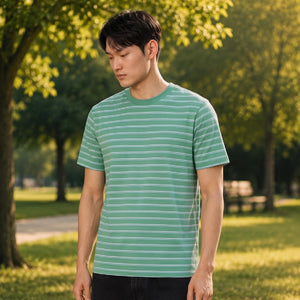


When you walk into a store or casually browse online for a high-performance gym t-shirt, the fabric description is almost always dominated by the big two synthetic fibers: nylon and polyester.
You may feel that both fabrics offer similar benefits. They are lightweight, flexible, and do a good job replacing a cotton tee that gets uncomfortably heavy after any activity. But both these materials have very different properties. So knowing what’s right for you becomes crucial.
While both belong to the synthetic family and thus share some structural factors, that’s where their similarity ends. The underlying fibres react very differently to sweat, movement, heat, and physical friction. Let’s compare nylon fabric tees with polyester t-shirts to help you choose the right performance gear for your needs.
How It Feels On The Skin
This is the first thing you notice when putting on a t-shirt - how it feels against your chest and shoulders.
-
Nylon: It was made as a synthetic alternative to silk, so high-density nylon fibers give a smooth and supple feel. A nylon spandex blend like that used in XYXX Activewear takes it further by providing additional stretching ability and minimising seam friction and skin irritation during intense movement.
-
Polyester: Polyester fibres are naturally stiffer and feel slightly crisper to the touch. While modern micro-knit and open-mesh technologies have drastically improved polyester softness, nylon still holds a slight distinction in pure skin feel.
Sweat Management in Active Settings
The feel may be superficial, but how the garment handles sweat is what truly sets it apart in activewear. That’s where things truly diverge with these two fabrics.
-
Polyester: It is naturally hydrophobic, meaning its fibres repel moisture. It absorbs close to zero moisture. If it is combined with sweat-wicking technology, then the sweat is drawn away from your skin to the fabric's outer surface where it evaporates rapidly. This makes a specialised XYXX CoolMax t-shirt built on a polyester platform the ultimate choice for high-sweat activities like cardio.
-
Nylon: Nylon is slightly hydrophilic, meaning it holds onto a small percentage of water. While a moisture-wicking t-shirt built from technical nylon eyelet jacquard pushes moisture away efficiently, pure polyester still edges it out in the speed with which this process takes place.
How It Moves
Whether you’re working out or stretching out, fabric flexibility and strength play an important part. Let’s see how the fabrics differ in this department.
-
Nylon: Nylon has exceptional tensile strength and superior elasticity. It can go through a lot of friction against heavy equipment without tearing or pilling. It is sometimes blended with elastane to create a 4-way-stretch fabric that moves even more effortlessly.
-
Polyester: Polyester doesn’t shrink and doesn’t stretch out of shape even after repeated laundry cycles. This is a big advantage. But its natural elasticity is lower than nylon. It requires specific technological inputs or elastane additions to achieve full multi-directional mobility.
What We Know So Far
-
Nylon is silky and ultra-soft, whereas Polyester is crisp, lightweight, and holds structure better.
-
Polyester repels sweat completely, and its drying time is unmatched, whereas Nylon absorbs a tiny fraction of moisture but maintains high breathability.
-
Nylon has exceptional tensile strength and high snag resistance, while Polyester offers high resistance to color fading, losing shape, and shrinking.
-
We can conclude that Nylon excels in scenarios like heavy lifting, agility training, and as general daily activewear, whereas Polyester excels in extreme heat, high endurance cardio, and activities like outdoor running.
So Which Fabric Should You Choose?
This really depends on how you train.
Choose Nylon t-shirts if you prioritize premium skin feel, maximum mobility, and snag resistance in the gym. An XYXX eyelet jacquard raglan t-shirt made from a nylon-spandex blend offers supreme flexibility for lifting and dynamic training.
However, if you need maximum airflow, rapid sweat evaporation, and maximum heat regulation during hot summer runs or long endurance sessions, there is no comparison to polyester. A lightweight CoolMax technology t-shirt keeps your core cool when heat and humidity peak.
Frequently Asked Questions
1. Is polyester or nylon better for preventing workout sweat patches?
Polyester repels moisture faster, pushing sweat to the outer surface of your t-shirt for immediate evaporation. However, high-density nylon can also manage sweat effectively while offering a softer feel against the skin.
2. Which fabric holds up better against friction and snags?
Nylon features superior tensile strength and abrasion resistance, making it better equipped to handle repeated friction from gym equipment or accessories like wristwatches.
3. Does polyester activewear retain sweat odour more than nylon?
Untreated polyester can trap bacteria in its fibres over time. But polyester XYXX activewear is built with anti-bacterial finishes to prevent lingering smells and the associated discomfort.
4. Can I wash synthetic gym t-shirts in hot water?
It is best to wash both nylon and polyester activewear in cold water on a gentle cycle. High heat can degrade elastic fibers and compromise the shape-retaining ability of the fabric.
5. Why are synthetic activewear tees better than traditional cotton shirts for workouts?
Cotton absorbs sweat and becomes heavy. It stays wet and thus leaves you prone to chafing. Synthetic fabrics actively pull moisture away from your skin. They dry quicker to keep your t-shirt feeling light and breathable.