

It’s a visual often found in retro American movies, games, and TV shows. The main character is standing in an empty asphalt lot somewhere like Southern California in the late 1980s, contemplating life.
In the background, you can hear two distinct sounds very reminiscent of the time - the hard slap of skateboard wheels on concrete, and the fluttering of the fabric from an excessively large cotton T-shirt that the skaters are wearing, caught in the wind. This kind of public skate park was a distinctive feature of the era, and so were the clothes.
It’s not like those teenagers dropping their boards into empty swimming pools and sliding down handrails weren’t trying to make a fashion statement. They were probably buying those triple-XL crewneck tees from discount surplus bins.
Those big T-shirts were cheap and gave the skaters complete freedom to move. They could feel the wind move against their skin as they cut through it with their skateboard. They didn’t even have to worry about tearing a seam while trying a new stunt.
And if you took a hard spill on the pavement, the thick cotton layer offered just enough buffer to save a bit of skin.
All the way across the coast in New York and Atlanta, pioneers of early hip hop culture were simultaneously embracing the same kind of oversized fits. Tees with extra room that fell way past the hip line. It challenged the narrow and streamlined aesthetic of mainstream fashion.
This loose silhouette became a symbol of youth rebellion, counterculture, and deliberate defiance.
High-fashion experts at the time looked at these baggy T-shirts and loose pants with complete disdain. They were dismissed as adolescent slacker gear that your unemployed cousin wore every day to show that he was different.
Then, when you finally grew up and got a real job, you would be forced to squeeze into a tight, tailored suit. This feeling of freedom vs. restriction became almost symbolic of the two big movements taking over the country.
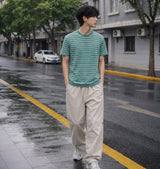
But today, oversized fits have become a staple on the runway and the streets, even during high-profile events like Paris Fashion Week. The definition of what’s fashionable and acceptable has flipped completely. Those loose, oversized t-shirts that once lived on the fringes have become the defining silhouette of 21st-century menswear.
More Than Just a Subculture
Oversized t-shirts didn’t travel from the skateparks straight to the runways overnight. It was a slow cultural takeover that stayed persistent despite the challenges.
Television has a big role to play in this as well. Through the 1990s and early 2000s, music videos and skate tapes internationally turned the oversized look into something cool and aspirational.
It was easy to access, which made it democratic and completely unpretentious.
But the real turning point was yet to come. In the years that followed, the generation that was raised on hip-hop, graffiti, and streetwear began taking over creative roles at European fashion houses.
Designers realised that modern men were tired of the restrictions placed on them, and it was largely symbolised by the stiff, restrictive suiting of traditional menswear. They recognised that men didn’t like feeling trapped - in life, in their jobs, or in their clothes.
They took the relaxed proportions of street culture, refined it to suit their tastes, and sent models marching down high-fashion runways in loose t-shirts.
Comfort and ease were not the enemies of high fashion now; they were the starting point.
Rethinking the Relaxed Silhouette
As the oversized tee of skateparks and hip-hop videos became an everyday staple, the design itself underwent an evolution.
In the early days, you would simply buy a regular t-shirt that was two sizes too big. But men soon realised there was a drawback to this DIY approach. The collars of these t-shirts sagged halfway down your chest, the sleeves fell well below your forearms and restricted movement, and the hem dragged down below your waist, making it look shabby.
Modern cotton and cotton-poly oversized t-shirts by XYXX preserve the essence of these pieces but are made with an entirely different geometry.
-
The Extended Drop-Shoulder: The shoulder seams of modern oversized t-shirts fall naturally down the upper arm, creating a broadened drape across the chest.
-
Finding the Right Sleeve Length: The sleeves are cut wider and finish right above the elbow. So they frame your arms with clean lines without being restrictive.
-
A Resilient Collar: Because loose fits rely on balance, the fitting of the neckband is crucially important. Modern oversized tees come with a shape-retaining ribbed neckband that keeps them looking sharp and structured even after multiple uses.
The Triumph of Easy Confidence
Looking back at those asphalt lots where skaters first put oversized tees on the map, the core appeal remains the same. The feeling of freedom, the unrestricted airflow across your torso, the ease of movement- these are all still a big part of choosing oversized fits. They tell you that t-shirts don’t need to follow rules and seek approval, and neither do you.
Oversized t-shirts aren’t just a trend that’s being blindly followed. They have a story that goes way back and taps into decades of counterculture rebellion.
Frequently Asked Questions
1. Do oversized t-shirts make you look shorter?
Not if you choose an oversized tee with a hem that falls just around the hip area rather than past the thighs. You can also pair it with straight-cut or slightly tapered bottoms to maintain your body proportions.
2. What is the difference between getting an oversized fit and just buying a larger size?
A purpose-built XYXX oversized T-shirt is designed with dropped shoulders, wider sleeves, and a roomier chest, while keeping the collar circumference and overall body length proportionate to avoid excessive hanging. A larger-sized t-shirt can sometimes just end up looking like a nightshirt.
3. Why are cotton-poly blends popular for oversized t-shirts?
Blending cotton with durable polyester gives an oversized t-shirt a structured drape that resists deep wrinkles and prevents the collar from stretching out even after repeated machine washes.
4. Can you tuck an oversized t-shirt into your pants?
Yes. A loose tuck creates a retro, balanced silhouette that highlights your waistline while preserving the volume across your chest and shoulders.
5. How do you style an oversized tee for a smart-casual setting?
Choose a minimal-looking, solid-colored XYXX oversized T-shirt in a deep shade like navy or black. Pair it with Zero Pants, and complete the look with minimal white sneakers.