


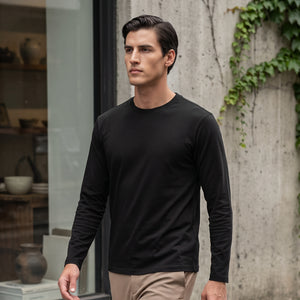
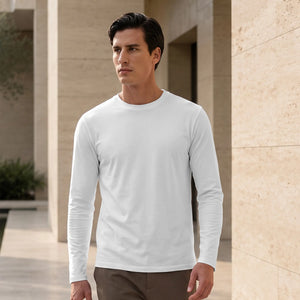



In a category long dominated by machismo and celebrity endorsements, XYXX chose social observation, humour and a baniyan with something meaningful to say.
What if men faced the same scrutiny for visible vest lines that women often do for visible bra straps?
That question sits at the centre of XYXX’s latest campaign, "If Baniyans Were Bras", a role-reversal film that imagines an alternate reality where men are judged, stared at, and commented upon because their baniyans are visible.
Created in collaboration with content creator and Pink Sauce Studios founder Vir Saini, the film has quickly gained traction online for its humour and social observation.
But for XYXX, the campaign wasn't conceived as a social statement. It began with a product objective: drawing attention to its Invisible Vest, a seamless innerwear product designed for younger consumers who have largely moved away from traditional baniyans.
Did the campaign speak more to women than men?
At first glance, If Baniyans Were Bras appears to speak more to women, given that it draws on experiences many women instantly recognise. But XYXX says that wasn't the original intent.
According to Petal Gangurde, chief of brand and culture at XYXX, the campaign was conceived as a creative storytelling idea, not a commentary on gender norms, though the team knew it would resonate with women while remaining relatable for men. "The idea was to create an alternate universe using those nuances as a storytelling device," she says.
Saini adds that while they expected women to share the film more widely, the product remained central to the narrative. "It's still a baniyan ad," he says.
The insight stemmed from a simple observation: vests are often overlooked, while bras attract disproportionate attention and commentary. By flipping that dynamic, the team found a fresh way to spotlight the category.
Vir Saini, founder, Pink Sauce Studios; Petal Gangurde, chief of brand and culture at XYXX
A baniyan ad unlike most traditional innerwear ads
The men’s vest category has traditionally relied on a familiar advertising formula: hyper-masculine imagery, celebrity endorsements and product demonstrations. From Salman Khan's long-running association with Dixcy Scott and campaigns built around physicality and star power, to classic category slogans such as Lux Cozi's "Yeh Aaram Ka Maamla Hai", innerwear advertising has typically focused on comfort, performance and masculinity rather than storytelling or social observation.
"We've actually never done machismo. If you look at our campaigns over the last seven years, they've never really been about masculinity. To be very honest, they've largely been about product performance," says Gangurde.
"We knew it had the potential to go viral from the start," says Saini. The idea stemmed from a simple observation: while bras often attract social commentary, visible vest lines rarely do.
"Baniyans are an afterthought," says Saini. "Bras, on the other hand, are contentious and constantly discussed. We thought, what if a baniyan got the same spotlight that a bra gets?"
The resulting film exaggerates everyday situations to create a fictional world where men experience the same unsolicited attention and commentary women often navigate.
In the age of scrolling, feelings come first
The campaign's strongest weapon is humour.
Saini believes that in a social media environment where attention spans are shrinking, brands must first make people feel something before attempting to sell a product. "People don't come to Instagram to watch ads. They come to be entertained, to escape, to feel something," he says.
According to him, advertising today broadly follows two routes: emotional inspiration or humour. Pink Sauce's creative philosophy has largely gravitated towards the latter. The studio has previously employed a similar approach in campaigns such as XYXX's History in Briefs, which humorously reimagined historical figures like Aryabhata to talk about men's innerwear.
"The whole piece has to be rooted in one question: What is the feeling we're trying to evoke?"
For XYXX, the strategy appears aligned with how the brand views contemporary content consumption. Gangurde argues that shareability has become a more meaningful metric than traditional advertising visibility.
"The real currency today is shares on social media. If people are talking about it and sharing it, you've already achieved something meaningful," she says.
Why XYXX moved on from KL Rahul?
Despite its efforts to move away from traditional innerwear advertising codes, XYXX initially embraced celebrity endorsements. Cricketer KL Rahul joined as the brand's first ambassador and investor in 2022, helping boost its visibility. However, the partnership ended in late 2024 as XYXX shifted towards digital-first storytelling, creator collaborations and content-led marketing.
"Consumers are increasingly saturated with celebrity advertising, and simply putting a famous face in a campaign is no longer enough," she says.
The company has since shifted its focus towards ideas, storytelling and creator collaborations that feel more native to digital platforms. The move reflects XYXX's broader transition from a retail-led brand with a stronger presence in western India to a digital-first business with pan-India reach.
The backlash question
Any campaign that touches on gender dynamics inevitably risks polarising audiences online.
The team was aware of that possibility but says it wasn't a major concern.
"Audiences today are smart enough to recognise what's coming from a genuine place and what's based on a fabricated insight designed simply because it might sell," says Saini.
Gangurde believes the execution helped avoid unnecessary controversy.
"It wasn't trying to attack anyone," she says. "It was simply taking a familiar reality and flipping it in a humorous, relatable way."
"What if baniyans were bras?" served as a deliberate hook, she says. "But we wanted it to remain rooted in observation and humour rather than activism."
Not a dying category, just a changing one
While many younger consumers may no longer wear traditional baniyans the way previous generations did, XYXX believes the category is evolving rather than disappearing.
Gangurde says the brand's recently launched seamless, invisible vest has already sold out twice within eight months and is on track for a third sellout. The response challenged the company's earlier assumption that vests were becoming irrelevant.
"What we've realised is that consumers aren't rejecting the category; they're rejecting traditional products," she says.
According to Gangurde, consumers still want vests, but they expect modern features such as seamless construction, better fit, lightweight fabrics and breathability. The shift, she says, is from traditional products to more contemporary ones.
"The category is evolving, not disappearing. Consumers still want the functionality, but they expect it to be designed for modern lifestyles," she adds.
According to IMARC Group, the Indian male innerwear market was valued at $10.20 billion in 2024 and is projected to reach $16.30 billion by 2033, growing at a CAGR of 4.8% between 2025 and 2033.
Alongside legacy players such as Jockey, Lux Cozi, Rupa, Dollar Industries, and VIP Clothing, a new generation of digitally native brands, including XYXX, DaMENSCH, and Tailor & Circus, are attempting to redefine the category through product innovation, premiumisation, and content-led marketing.
What's in a name? The story behind XYXX
According to Gangurde, XYXX was intentionally designed to be an unusual name that sparks curiosity.
The inspiration comes from human chromosomes.
"Scientifically, all of us are identified by a pair of chromosomes that are 99% similar. It's the final 1% that makes each individual unique," she explains. The brand name, she says, reflects XYXX's ambition to help consumers express that distinction in a category often perceived as undifferentiated.
Who is XYXX's core consumer?
XYXX's primary target audience is the modern Indian man in his late twenties. Gangurde describes XYXX consumers as ambitious, upwardly mobile, and focused on self-improvement.
"He's building wealth rather than inheriting it and is constantly looking to upgrade different aspects of his life," she says. The brand's sweet spot lies in the 28–30 age bracket—consumers who have achieved a certain level of stability and are already working towards their next milestone. Rather than targeting first-jobbers or older consumers, XYXX positions itself as an upgrade for this aspirational demographic.
An omnichannel play with digital at its core
While XYXX maintains a presence across retail, e-commerce and quick commerce, digital channels have become increasingly central to its growth strategy.
According to Gangurde, the brand ranks among the top two or three players across several major e-commerce and quick-commerce platforms, while its own website remains a key sales driver.
Distribution trends vary by region, with general trade performing strongly in North and West India, the website seeing traction in southern markets, and quick commerce doing particularly well in cities such as Jaipur and Lucknow.
"The top three platforms for us would be our own website, e-commerce and quick commerce," she says.
Why Jockey remains the key competitor
In offline retail, XYXX sees Jockey as its closest competitor. Unlike mass-market players such as Lux, Dollar and Rupa, the brand positions itself in the premium segment through product innovation and higher price point, with most innerwear products priced between Rs. 240 and Rs 600. "We don't really compete with mass-market brands because our positioning remains firmly in the premium segment," says Gangurde.
To strengthen its retail footprint, XYXX has focused on visibility initiatives such as store branding and on-ground marketing across the country's top 50 cities. However, the company is also adapting to changing shopping habits.
While retail remains important, Gangurde notes that increasing numbers of consumers are shifting towards e-commerce and quick commerce, influencing how the brand approaches future expansion.