

People have been experimenting with stripes in clothing for ages. There are horizontal stripes, vertical stripes, black stripes, colourful stripes, even diagonal stripes in modern clothing. But as their popularity grew, there was a single style rule that got repeated so often that it managed to imprint itself onto every man's brain: never wear horizontal stripes unless you want to look wider than you are.
It’s a piece of dressing advice passed down to younger generations like gospel, right alongside “always match your belt to your shoes”. This has led many a man to look at a striped t-shirt on a shelf and picture themselves looking wider, and forming an undesirably boxy silhouette. They then quietly put it back in favor of a plain black or navy tee, and it’s business as usual.
It’s easy to understand why men might have reached this conclusion after seeing some anecdotal evidence. However, if you dig a little deeper, you’ll find that visual science doesn't fully back up this rule.
The idea that horizontal stripes automatically make you look broad and bulky is a gross oversimplification because the way we perceive stripes comes down to a mixture of line width, negative space, color contrast, and cut.
When you understand the visual trick behind why this pattern is so popular, you’ll quickly see that horizontal stripes aren’t something to fear. You can, in fact, use them to your advantage to sharpen your frame and enhance the visual of your overall build.
Let’s Understand How Your Brain Sees Lines
There’s a visual effect stripes use, and it involves how our eyes move across a garment.
When you look at someone wearing vertical stripes, like a railroad-stripe shirt or a pinstripe suit, your eyes will naturally follow the lines to move up and down. This way of vertically scanning the pattern creates the optical elongation that we feel makes the wearer appear slightly taller and leaner.
Horizontal lines, on the other hand, encourage your eyes to scan from side to side, like reading a piece of text.
What this horizontal scanning does is force your brain to register the outer edges of the line. That’s where the perception of the stripes making you look bulky comes from.
But if those lines sit across the right areas on your torso, that horizontal sweep highlights your natural shoulder width, enhancing the visual of an athletic V-taper.
The Variables That Actually Matter
Not all stripes flatter your frame, though. The scale and placement play a big part in how they affect your frame.
-
Stripe Thickness: Broad, heavy bands of color, say 2 to 3 inches wide, dominate the garment. If they land across your midsection, they draw focus straight to your waist and make it look broad. Micro-stripes or medium-gauge lines, by contrast, form a cohesive pattern with the base colour of the t-shirt, and they appear as a unified surface rather than separate bars.
-
Negative Space: The background color of a t-shirt acts as breathing room between the stripes. So stripes that are grouped closer together with narrow spacing, look more like a cohesive group. This helps them blend into the fabric rather than stand out and create a barrier.
-
Color Contrast: This is an underrated factor when it comes to choosing the right striped tee. A high-contrast pairing, like stark jet black bars over something eye-catching like a neon yellow, creates an intense visual that exaggerates width wherever the contrast is sharpest. Subtle and soft neutral colours like powder blue with yellow or white with green create smooth, flattering gradations.
Styling Stripes for the Look You Want
Mastering stripes allows you to use them as visual anchors around which you can design your outfit. This helps you get the most out of the pattern. Here’s how you can style them to get the exact look you’re going for.
-
Broaden Narrow Shoulders: Opt for a simple striped tee where the lines run across the upper chest and sleeves while the rest of the t-shirt remains relatively clean for creating the visual of having broader shoulders. This naturally pulls the viewer's eye toward your shoulders and upper back.
-
Layering to create a frame: Layer your striped T-shirt under an open solid overshirt or a casual zip-up jacket for more formal occasions. The open front of the jacket creates two strong vertical lines that frame the stripes in the center, delivering the desired broadening effect across your chest while keeping your torso visually lean.
-
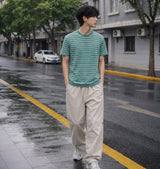
Choose Bottomwear without Clashes: Always ground a patterned top like a striped tee with clean, solid-colored bottoms like chino shorts, dark cargo pants, or relaxed Zero Pants. Letting the t-shirt be the focal point keeps the overall look intentional and polished.
Never Stripe Out
Stripes don't dictate the kind of visual your torso creates; your styling does. That old rule warning you away from horizontal lines was never about the pattern itself. It probably originated from some poorly chosen cuts, oversized bands, and bad proportions.
So, the next time you catch yourself putting back a horizontally striped tee, remember that well-spaced stripes can enhance your frame more than your favourite solid tee.
In fact, it is one of the easiest ways to add variety, depth, and character to your wardrobe.
Frequently Asked Questions
1. Do horizontal stripes always make you look heavier?
No. Broad, widely spaced stripes can draw attention to your waist and make you look wider, but smaller, balanced stripes create a cohesive pattern that broadens the shoulders rather than adding bulk.
2. Can shorter men wear horizontally striped t-shirts?
Yes. Shorter men can wear stripes but narrower stripes with low contrast are likely to suit them better. You can also layer the tee to introduce vertical framing lines.
3. How should a striped t-shirt fit to avoid looking bulky?
Look for a clean regular fit that falls comfortably over the chest and falls straight over the waist. Avoid very tight fits that distort the straight lines of the pattern. Even excessively oversized cuts that can add fabric bulk around the sides.
4. What bottoms pair best with a striped cotton tee?
Striped tops look best when paired with solid-colored bottoms such as cargoes, chino shorts, or easy pants to avoid competing patterns and maintain visual balance.
5. How do you wash a striped t-shirt to prevent color bleeding between the lines?
Wash your striped t-shirts inside out in cold water on a gentle cycle with similar colors. Avoid harsh bleaches or hot-water cycles that can cause dark stripe dyes to bleed into lighter panels.