


The Case for Bamboo: Why Fabric Matters More in Your First Layer
You know that feeling when your manager doesn't give you due credit for a project you've been working overtime on? Yeah, your innerwear probably feels the same way. It does a lot of the work and gets almost none of the attention.
We generally focus a lot more on how something looks than how it actually feels. It shows up in the individual pieces we choose - like picking the better-looking trousers over the more comfortable ones - but it also affects what we choose to prioritise in the first place. No one can see what's underneath, so why spend much time thinking about it? Everyone sees the shirt, the trousers and the jacket. So, naturally, those are the pieces we also notice first and spend the most time getting right.
But maybe we're approaching it the wrong way.
Maybe the base of a good outfit is actually good comfort. If your innerwear is rubbing against your skin, holding on to sweat or trapping heat, you are going to feel it. And the discomfort is going to show in rather unflattering ways. Like the constant adjusting or the simple annoyance of clothes that refuse to work with you.
I think it would also be fair to say that the base of a comfortable outfit is comfortable innerwear. Your innerwear is the first layer against your skin. If it’s too rough, you'll notice it. If it’s too warm, you'll notice it. If it’s too heavy or damp, you'll definitely notice it. It doesn’t matter if your outerwear is of the best material if what you directly feel against your body isn’t.
And so if comfortable innerwear is the base for a comfortable outfit, and good comfort is the base for good looks, quality innerwear really is the best route to achieve both - looks and comfort.
It All Starts With The Fabric
You can get the fit, cut, and construction right, but if the fabric isn't working with you, none of the rest matters quite as much. Fabric pretty much dictates how your innerwear will react to anything you and your day throw at it. The difference isn't always something you consciously notice; it could simply be the absence of discomfort.
Fabric affects how soft it is. When something sits against your skin for hours, softness becomes more than just a nice feature. A rough or stiff fabric can create friction and irritation over time, while a softer one is gentle on the skin and feels much easier to wear for longer.
Fabric affects how it handles heat. It also plays a role in how warm or stuffy a garment feels. A lightweight, breathable fabric allows more air to move through it, while heavier or less breathable materials can leave heat feeling trapped against the body. You don't necessarily want to feel like you've added another winter layer when you're just wearing a vest.
Fabric affects how it handles sweat. Your innerwear is the first layer to come in contact with your skin, and by extension, your sweat. If it’s made of a moisture-wicking fabric, it can help move sweat away from the skin. But if it's made from a fabric that holds on to it, it can leave you feeling damp and sticky.
Fabric affects how it moves. If your underwear resists every small movement you make, it becomes noticeable, and it becomes noticeable in all the bad ways. The right fabric can help it bend, stretch, and move without constantly pulling at your skin. The wrong one can make even simple movements feel restricted or leave the garment feeling like it's fighting against you.
All of these factors also affect how your clothes look from outside. We already discussed the discomfort innerwear resolves and how that indirectly affects appearances. But innerwear can also affect how your outfit looks in the most direct ways. How it handles moisture, how it sits against your body, and how much bulk it adds can all affect what your outfit looks like from the outside.
All in all, the first layer plays a lot of roles, and how it fares in those roles is largely dependent on the fabric it is made from.
The Role Of Bamboo
That's where bamboo comes in.
Bamboo has been having a bit of a moment in clothing and for good reason. We have already discussed what criteria make a fabric ‘good’ for innerwear.
And bamboo viscose checks quite a few of those boxes.
For starters, there's the softness. Bamboo viscose has a smooth, soft feel, making it extremely gentle on your skin. It feels better; it feels premium.
Then there's breathability. Your first layer is already sitting underneath another piece of clothing, so adding a heavy, stuffy fabric isn't exactly helping. Bamboo's lightweight, breathable structure helps keep the layer feeling lighter and more comfortable, especially during warmer weather.
And then there's sweat. A fabric that sits this close to your body needs to handle moisture properly. Bamboo fabric is moisture-wicking, helping move sweat away from the skin. Its thermoregulating properties also adapt to your body temperature, keeping you cool in warmer weather and warm in colder weather.
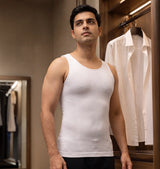
The XYXX's Bamboo Invisible Vest further builds on these qualities using a 95% bamboo viscose and 5% spandex blend. The bamboo provides a soft, dry, lightweight, and breathable feel while the added spandex brings stretch and makes movement easy.
With the added construction details in its design and the existing quality of its fabric, the vest solves problems you didn't even know you had.
How You Build On It
The XYXX Bamboo Invisible Vest carries the same dedication to comfort it shows in its fabric into its structural design. It has seamless armholes and a seamless neckline to create a no-impression finish. No hard edges are digging into your skin, and fewer visible lines give away what's underneath your shirt, giving you a more polished look. Even the sleek square neck gives you a clean finish by keeping the vest discreet underneath the shirts and T-shirts you're actually wearing.
The contoured seams and modern cut also help the vest sit closer to the body, making it move with you instead of bunching up as you go about your day. And because you're wearing it for hours, the design also focuses on reducing irritation and chafing.
The XYXX Bamboo Invisible Vest is constructed around a very simple idea - if your innerwear performs, the rest of the outfit will follow.
Stop Ignoring The First Layer
We tend to think of innerwear as the easy part of getting dressed. Pick one, put it on, and forget about it.
But that's exactly why getting it right matters. The wrong underwear will make its presence known in the most subtle ways, staying in your thoughts unconsciously. The right innerwear makes you forget it's even there.
XYXX Bamboo Invisible Vest helps your innerwear do just that by bringing together softness, breathability, lightweight comfort, moisture management, the right stretch, and an invisible design in a garment that is made for staying closer to your body.
Check out the XYXX Bamboo Invisible Vest and rethink what's sitting closest to your skin.
Frequently Asked Questions (FAQs)
Q - Why is fabric important in innerwear?
Answer: Fabric affects how soft, breathable, and lightweight your innerwear feels, as well as how well it wicks moisture away, making it an important part of everyday comfort.
Q - Is bamboo fabric good for innerwear?
Answer: Yes. Bamboo viscose is soft, lightweight, breathable, and moisture-wicking, making it well-suited for innerwear that sits directly against the skin for long hours.
Q - Does bamboo fabric help with sweat?
Answer: Bamboo fabric is moisture-wicking, which means it helps move sweat away from the skin. This can help the fabric feel drier and more comfortable throughout the day.