


You have probably seen it while shopping for clothes these days - 148 GSM, 152 GSM, 180 GSM. A quick Google search, “What is GSM?”, will tell you it’s Global System for Mobile Communications. It’s not in this context.
GSM in fabric stands for grams per square metre. In simple terms, it tells you how much a square metre of fabric weighs. A 150 GSM fabric weighs 150 grams per square metre, while a 200 GSM fabric weighs 200 grams.
In even simpler terms, it tells you how thick a fabric is. For everyday clothes, a thicker fabric is considered to be of higher quality. But in the case of activewear, a lower GSM might be more suitable. A lightweight fabric handles heat, moisture, and movement more effectively than a higher GSM fabric.
When it comes to GSM, a higher number does not automatically make a fabric better. What makes a fabric good is its ability to make you feel good, and that completely depends on your environment and circumstances.
What Should You Understand From GSM?
GSM tells you the amount of fabric that will sit between you and the world. It gives you a useful starting point in deciding where, when, and how you might want to wear your outfits by helping you understand how a garment is likely to feel.
A high-GSM T-shirt tends to feel warmer and more structured, making it better suited to cooler weather, air-conditioned interiors, or occasions where you want a more dressed-up look. Wearing one during a workout, on the other hand, may leave you feeling trapped in heat. A lower-GSM T-shirt tends to feel lighter and easier to wear, which can make more sense for intense workouts like HIIT, running, cycling, gymming, or even everyday wear in warmer climates.
What’s The Logic Behind GSM and Its Effects on Activewear?
Now you know that GSM isn’t just another technical number on a product page. It not only has a direct effect on how a fabric falls on your body or how much air gets through it, but it can also play a part in your decision-making process.
Which One Has More Breathability?
Higher GSM fabrics are denser and thicker. This means there is more material between your skin and the air. That restricts airflow and traps more body heat, keeping you warm. Lower GSM fabrics, in contrast, are lighter and allow air to move more easily through their structure, making them better suited to keeping the body cool. So during a workout, when your body naturally generates plenty of body heat, a gym T-shirt or sports shorts for men of lower GSM would be a good idea, as it can keep the garment from feeling like an extra layer. The same applies to outdoor workouts, especially in India's heat and humidity, where airflow is even more valuable.
Why Do Lower GSM Clothes Feel Softer?
Lower GSM fabrics generally feel lighter and softer because they use less material and often have finer yarns. With less weight and rigidity in the fabric, the material can move more easily against your skin instead of feeling stiff or heavy.
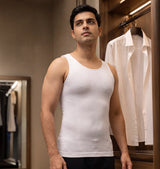
That is also what makes it less cumbersome through repeated movement during a workout, explaining why a lower GSM is a recurring feature for activewear for men. A good example of this could be The XYXX CoolMax Performance T-Shirt and Coolmax Performance Tank. They are made from a lightweight 148 GSM fabric, making them light, comfortable, and well-suited to workouts.
That being said, GSM still isn’t a measure of softness.
A low GSM number doesn't automatically make a fabric soft. The fibre itself plays a major role. The quality of the yarn, the type of fibre, and how the fabric is finished can all change how it feels against your skin.
How Does it Affect Overall Comfort?
Well, heavier fabrics are quite comfortable for when you want warmth, structure, or a more substantial feel. They work well in cooler weather, air-conditioned spaces, or occasions where you want your clothes to hold their shape and look more polished. A workout isn’t any of those places, however, making higher GSM fabric a misfit for activewear.
Lighter fabrics offer the right kind of comfort when it comes to gym wear for men. They feel less restrictive, allow more airflow, and are easier to wear for longer periods. That makes them useful for workouts or anything that involves a lot of movement.
Fabrics with different GSMs have distinct use cases. Interchange the use case, and the qualities that offer comfort will then become the source of your discomfort. A heavier fabric can be comforting when visiting an air-conditioned mall, yet the same fabric can become a personal sauna when working out in the Mumbai humidity and heat. Lightweight fabrics, on the other hand, are preferred for movement-heavy days. Not so much for the chilly evenings out.
The qualities of lightweight fabrics also make them particularly well suited to athleisure. When a garment needs to move with you, keep you comfortable through heat and sweat, and still work for everyday wear, less fabric weight can be a pretty good place to start.
But Is GSM The Only Thing That Matters in Activewear?
No, GSM is only one part of the equation when it comes to athleisure. The GSM of a gym T-shirt cannot single-handedly help you with breathability and movement. If a gym T-shirt for men holds on to moisture, no matter how lightweight the fabric, the cloth will add weight to your body. If the seams of a t-shirt are wrongly placed, the movement will be restrained regardless of how easily the fabric itself moves. This makes other qualities like moisture wicking, quick drying, and the construction of the garment essential too.
GSM is useful because it helps you understand how the garment is likely to feel during a particular activity. But good workout clothes don't stop there. They back it up with fabric construction and technology.
XYXX's Performance Range shows this understanding through various other features. Their XYXX CoolMax Performance T-Shirt and CoolMax Performance Tank use CoolMax® thermoregulating fibres designed to keep you up to 2°C cooler in heat, along with moisture-wicking and quick-drying properties.
Their Performance Raglan T-Shirt, with its jacquard-knit construction, is designed for breathability, while its four-way body-responsive stretch allows the fabric to move with you. The raglan sleeve construction also removes the general shoulder seam, further allowing movement.
All three garments also have features like snag resistance, shape retention, quick drying, durability, and more. This range of features beyond GSM is a testament to the brand’s commitment to making sportswear for men that works for them in as many ways as possible.
The Right GSM is The One That Works For You
GSM isn't a number you need to chase. There is no universally right or wrong GSM; different fabric weights simply bring different qualities to the table. Heavier fabrics can offer warmth and structure, while lightweight fabrics make more sense when you want airflow, ease, and freedom of movement.
For activewear for men, those lightweight qualities are especially useful. They make gym wear for men easier to move in, more comfortable in the heat, and practical beyond the workout too.
XYXX brings these qualities, and more, together across its men's activewear with lightweight options designed for workouts and everyday athleisure for men.
So the next time you see a GSM number, don't ask whether it is high or low. Ask whether it works for you.
Explore XYXX's activewear collection for lightweight sportswear for men built for movement, comfort, and everyday wear.
Frequently Asked Questions (FAQs)
Q - What is activewear and how is it different from regular clothes?
Answer - Activewear is designed for movement, with features like 4-way stretch, breathability, and quick-drying fabrics. Unlike regular clothes, it’s built to keep you comfortable, dry, and unrestricted during workouts and active days.
Q - What is the best fabric for running in hot weather?
Answer - Look for lightweight, moisture-wicking, and quick-drying fabrics. Our CoolMax fabric is lab-tested to help keep you up to 2°C cooler, while its 148 GSM construction keeps it incredibly lightweight.
Q - How fast does a quick-dry t-shirt actually dry?
Answer - A quick-dry t-shirt can dry in just a few minutes, depending on the fabric and technology. The XYXX active raglan t-shirt dries in 4.8 minutes, while the Coolmax tee dries in under 7.6 minutes, helping you stay fresh through every training session.