

It’s a battle for becoming the undisputed heavyweight champion of men’s innerwear.
In one corner is the defending champion, cotton, who has held the crown for centuries. It has been a part of everything from your work shirts to your favorite weekend T-shirt. It is familiar. It is reliable. It washes easily, lasts for years, and has been the foundation of modern clothing.
In the opposite corner is the challenger who is the new kid on the block, Bamboo. Known fondly as the next big thing, this kid has quietly been rising through the rankings as the fabric of choice for its breathability, smoothness, and unmatched bacteria resistance.
These two icons will be locked in battle to achieve the legendary status of being the fabric of choice for men’s vests. Bamboo wants to be "the next big thing," while cotton wants to prove that old is truly gold.
Let the battle begin!
1. The Tactile Experience
First and foremost, let’s look at how the fabric interacts with your skin.
-
Cotton Fibre: Traditional cotton fibers are naturally irregular. This irregularity provides cotton fabric with structure, grip, and texture. However, in a vest, that unevenness can cause surface friction. Also, repeated exposure to heat and humidity can cause the fibres to fray and stiffen, resulting in a coarse hand-feel.
-
Bamboo Fibre: Bamboo-derived cellulose forms long, uniform, and exceptionally round filaments with minimal surface friction. The result is a knit with a smooth drape that glides effortlessly across sensitive skin, particularly in garments like an invisible vest. The fibres resist fraying so the fabric maintains that softness through dozens of laundry cycles
2. Thermal Airflow
How a vest circulates air determines whether you stay cool or end up feeling like you’re sitting in a furnace.
-
Cotton Fibre: Conventional cotton provides reliable breathability. However, its fibres tend to form a dense weave that traps air, particularly when it’s wet. The density helps your shirt hold its structure better. But in humid conditions, that trapped air can quickly make your torso feel stifled.
-
Bamboo Fibre: Bamboo fibres are punctuated with many tiny channels and perforations. These microscopic gaps improve ventilation across your skin, promoting continuous air circulation. So, your body heat is vented away before you start to feel the negative effects associated with it. This thermoregulation keeps you cool in the summer and warm in the winter.
Advantage: Bamboo
3. Moisture Management
Things were pretty close so far. But sweat management is where bamboo fibre pulls far ahead with its superior wicking and rapid drying ability.
-
Cotton Fibre: Cotton genuinely loves hanging on to water. It excels at quickly soaking up your sweat so that you don’t feel it directly on your skin, but it also locks that moisture into the fibre. Once fully saturated, cotton refuses to shed that water easily. The fabric becomes heavy and clings uncomfortably to your chest and back.
-
Bamboo Fibre: The fibres of a bamboo vest allow for active capillary dispersion. Instead of storing sweat, they rapidly wick it away from the skin and spread it across a wide outer surface area. Your ambient body heat and flowing air do the rest.
Advantage: Bamboo
4. Durability
Cotton has unmatched durability. That goes without saying. Though bamboo fibre is 2X softer, it has lower tensile strength.
-
Cotton Fibre: Cotton fibres actually increase in tensile strength when wet, allowing cotton garments to take daily machine washing, spin cycles, and tumble drying without warping. They also handle physical friction and abrasion exceptionally well.
-
Bamboo Fibre: Pure bamboo viscose, while unmatched in softness, can be delicate when it’s wet. It has lower wet tensile strength than pure cotton, meaning an all-bamboo vest can risk stretching out or losing shape if it’s run through several laundry cycles.
Advantage: Cotton
The Right Fiber for the Right Job
Though it seems like bamboo takes most of the rounds, it doesn’t hold an absolute advantage, so we can’t call this an unchallenged verdict.
While bamboo is better suited to handle everyday issues like chafing, skin irritation, sweat patches, and body odour, cotton remains the undisputed gold standard for its durability and familiarity.
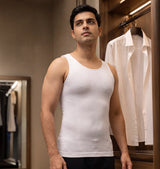
The best choice is a vest that has the best of both worlds, like the XYXX Bamboo Viscose Cotton Invisible vest. It has unparalleled comfort and anti-microbial properties from the bamboo fibres and higher durability compared to pure bamboo fibre. The best part is that it disappears under your shirt and silently works its magic.
So, we may not have found an outright winner in this debate, but we certainly found a champion.
Frequently Asked Questions
1. Is a bamboo vest cooler to wear than a cotton vest?
Yes. Bamboo fibres have microscopic gaps that allow continuous air circulation across the torso. This bit of ventilation cools body heat significantly faster than dense cotton fabric.
2. Can XYXX Bamboo Invisible Vests be washed in a regular washing machine?
Yes. When bamboo-derived fibres are blended with high-grade combed cotton, like in the XYXX bamboo invisible vest, the fabric gains reinforced tensile strength that withstands regular machine washing without losing its shape.
3. How does an invisible bamboo vest stay hidden under light shirts?
The XYXX Bamboo Invisible Vest has a deep scooped neckline that remains completely concealed beneath unbuttoned collars. It also features ultra-flat bonded seams that eliminate visible ridge lines even when worn inside thin or light-colored shirts.
4. Does bamboo fabric help prevent sweat patches from showing on outer clothing?
Yes. Bamboo fabric uses its natural sweat-wicking properties to pull perspiration away from your skin and disperse it thinly across the fabric surface. This makes evaporation much faster so that the sweat is eliminated before it can soak through to your clothes.
5. How does bamboo fabric handle odor compared to synthetic gym vests?
Traditional synthetic polyester vests tend to trap sweat and create an ideal environment for odor-causing bacteria within their fibres. Breathable bamboo blends allow your skin to feel ventilated. This naturally discourages the buildup of sweat odors.